by Hannah Collerson
The 2016 US election was one of the most controversial elections in modern American history. The two candidates, Trump and Clinton, were perhaps the most unpopular candidates that American politics has ever seen.
Trump’s win, despite Hillary winning the majority votes, didn’t exactly go down well with the millions of American’s who didn’t vote for him. It was the second time the Democrats have suffered at the hand of the electoral college system. The first time being Al Gore’s loss to George W. Bush, despite (like Hillary) him winning the majority vote.
The election between Al Gore and George W. Bush definitely brought some light to the flaws of America’s voting system, but the 2016 election had a much wilder reaction as emotions ran high.
Many people, Democrats and Republicans alike, are now questioning the purpose and legitimacy of the American voting system. The Electoral College may date back to the 18th century, but quite frankly, it’s not surprising that people are now questioning the whole system.
After all, isn’t it a government for the people, by the people? So, why aren’t the people in whole deciding? Why isn’t the popular vote rather than the Electoral College deciding our president? Well, for starters – it’s complicated.
How does the Electoral College work?
The process used in America to elect a President is called the electoral college. The idea behind it is that the President is decided by both the popular vote and a vote in Congress.
Everyone qualified to vote can do so, but ultimately, it’s the overall state vote that matters.
Each state has electors, who are decided before the general election by their parties. The number of electors each state gets is the same as the number of representatives (Congressmen and Senators) that they have in the House of Representatives. The number of representatives is determined by the size of the state’s population, and so the number of electors each state has is also dependent on the state’s population.
You’re now probably wondering why the number of electors matters so much. It matters because for a President to be elected, they need at least 271 of 538 electoral votes, otherwise the House of Representatives decide the winner.
So to put it simply, the biggest states have the most impact on the vote (which is why Trump focused his campaigns at the more populated states like Texas and Florida).
How it Started
Back in 1787, the Constitutional Convention – a group of delegates that met to discuss the flaws of the central government, considered several methods of choosing the next president.
Should the Congress select the next president? The state governors? Or should it be a direct popular election?
These were all options considered, but finally the matter was handled with a method called the ‘electoral college.’ It was widely approved by the delegates and political leaders. Therefore, after adding the system to the Constitution, each state was given a number of electors due to the combined membership of the Senate.
How it’s changed
The voting system has been modified a bit over the centuries. Originally, states chose electors equal in number to the representatives and the senators. The electors voted for two candidates, and the person with the majority of votes became President. The runner-up became Vice President.
So, essentially – there was no clear presidential or vice-presidential candidate.
Today, to become president – the candidate has to win an absolute majority of 270 electoral votes. Now, if neither candidate receives enough delegates, the House of Representatives will decide the winner from the top 3 candidates with the most electoral votes. Presently, the number of electors per state ranges from three to 54, giving a total of 538. But again, you can see how the bigger states have the most say.
Misinterpretation of Democracy
Protests and general uproar have accompanied an increased lack of faith in America’s voting system. People have begun questioning how a system that allows the most unpopular candidate to become President can be called a democracy.
So is it fair? Well, it depends. We have been attached to the idea that ‘we the people’ are deciding our own president, but it’s more of an indirect voting.
Many Americans believed they were voting directly for the candidate of their choice. But, technically – it’s the representatives of their local government that will actually decide for them. Voters in Broward County may cast the majority of ballots for Hillary Clinton, but the elector can decide to vote for Donald Trump instead.
When you think of democracy you probably think of the people electing parties and Presidents based on what the majority want. But the thing to remember is that we also misinterpret the country as a democracy. America isn’t a democracy, it’s a republic. The general public may refer to it as a democracy but even the constitution declares the nation a ‘republic for which we stand.’
It may not be exactly democratic, but the electoral college has its advantages
So, besides the fact that the U.S. is a Republic – why can’t they use the popular vote to decide the president? To put it simply – there would be chaos without the electoral college.
The system may cause controversy around democracy, but it actually plays an important part in the stability of the country. If the voting system worked in a way where Presidents were decided purely by popular vote, the chances are that a whole load of people would run for President.
For instance, in the recent election, Hillary Clinton won the popular vote by 48%. The other 52% belonged to Donald Trump and third party candidates. If we merely chose a president because of the popular vote, we would be swamped with candidates. The electoral college encourages a system of two parties, making it a simple choice, and a choice that will always please a large amount of people, whether they are the majority or not.
For those who are upset with the outcomes of the recent presidential election, or even the Al Gore vs George W. Bush, you have to understand the chaos that would erupt from getting rid of the electoral college. It may not be the best system, but it’s the system left to America by its Founding Fathers. Over the next century, perhaps the voting system will be modified but it’s going to be a long time before we get rid of the age-old system.
by Madeleine Mason
Moving to another country is without a doubt a scary prospect. Not only are you leaving your familiar surroundings but if you, like me, move to another European country, this will more often than not mean that you have to communicate in a new language.
I come from the UK but lived in France for nine months and in September 2016, I moved abroad once again… but this time, to the Land of the Lederhosen (Germany).
Ever since I was a teenager, I knew that it was my goal to move abroad and experience another culture, speak another language and explore new places. I loved learning languages and knowing that I could spend time overseas ticked all the right boxes.
Anyone who knows me will know that I’m not the world’s most adventurous type. It’s unlikely that you’d find me trekking up mountains, abseiling or bungee jumping, but I do certainly get a kick out of living somewhere new.
The reality of moving abroad
It would be untrue to say that this passion for living abroad and experiencing a new culture hasn’t been tested throughout the years. I quickly discovered that the idea of moving abroad can often be romanticized and my once visions of wandering along French streets saying Bonjour to beret wearing people carrying their morning baguettes, of cycling through the towns being carefree and able to communicate without any difficultés soon changed.
The realisation of actually moving away from my town, friends, family and of course, the UK, now gripped me with an intense fear. A fear of the unknown which I had never experienced before.
I had chosen my degree course specifically to spend a year in another country and had waited for what had felt like an eternity to get there. Yet, somehow, I had never considered the practicalities of moving abroad beforehand. I hadn’t thought about admin such as opening up bank accounts and enrolling at universities, let alone actually being away from my nearest and dearest.
So, suddenly in August 2014, it was time to head off to France and begin my adventure.
As predicted, the realities of living away from home began to reveal themselves. Endless admin, heated discussions with accommodation staff about living arrangements, a lack of internet, not enough tea and much more. Furthermore, I was suddenly living in a new city, and as beautiful and characterful as Strasbourg is, I was suddenly yearning for the familiarity of my hometown.
And to top it all off, everything was in French.
Living abroad now felt somewhat overwhelming and exhausting. It wasn’t the carefree cultural experience which I had envisaged and soon, pangs of homesickness kicked in.
Yet, despite all this, I persevered.
An suddenly, semester one was done.
And I had made it.
Moving abroad is a rollercoaster, but it’s worth it
Despite my initial homesickness, the overwhelming admin and some accommodation challenges, (like having to move out because of a bedbug infestation…), I had managed to navigate my way through my first semester without too many hiccups. I had also managed to make a few friends along the way.
By placing myself in challenging situations, my French progressed in leaps and bounds. I was suddenly able to communicate with my friends in a more fluent way, I felt a lot more self-confident as a functioning independent woman and was completing ‘adult’ tasks such as making official complaints, opening a bank account and organizing insurance documents.
I suddenly realized how far I had come since those initial nerve wracking weeks away from family.
The first semester was a challenge, but my goodness was it worth it. I did it.
I continued living in France and completed two semesters out there. The second of which being much easier than the first. By the time the second semester rolled around, everything was familiar and I was enjoying my French vie. My experience of living in France also led me to where I am today.
As soon as I finished my year abroad in France, it was time to return to the UK and finish my studies. And whilst I was excited to be living in Blighty again, there was still a part of me which yearned to be abroad, experiencing the excitement of discovering a new place and immersing in the culture.
So off to Northern Germany I went. Yet this time around has been very different.
Living abroad as a post-Brexit Brit
Being a post-Brexit Brit abroad has been a unique experience.
Whilst I have definitely received a warm welcome from the Germans, I have been constantly questioned about my country’s decision to leave the European Union and what that means for the future. I have become a makeshift spokesperson for the UK government.
The uncertainty which surrounds the vote to leave has also meant that I have a strong desire to reap the benefits of a European passport whilst I still am able to. A passport which allows me to reside and work in any other EU member state without a visa. The unknown factors which surround the decision to leave means that the privilege of being able to travel freely may only last for another two years…
Therefore, in my opinion, moving and living abroad for a British citizen now has a totally new meaning. I now feel the need to capitalize on my opportunity of visa free living and travelling abroad whilst the opportunity still exists.
Being a Europhile Brit means that I feel I have an obligation to encourage as many Brits as possible to make the most of living abroad whilst it remains simple and flexible.
Moving abroad has molded me into a stronger, more independent and confident woman. I can communicate in three languages and am able to appreciate different countries from their perspectives. I have learnt so much about French and German history and culture, and in many respects, I have learnt to appreciate the UK in a new light.
I’ve developed a strong sense of European identity, and despite Brexit, that will never change.
So I urge you, people of Britain and elsewhere, make the move. Whether it be for a month or a year, give it a try. You won’t regret it and will always cherish it.
by Hannah Collerson
You need to go on holiday to Mecklenburg-West Pomerania.
Never heard of it?
Well don’t worry, you’re not alone. If you had to name a German Bundesland (Federal state), your first thought is probably Bavaria, rather than Mecklenburg-West Pomerania, or ‘Meck-Pom’ as the locals call it.
But Meck-Pom is a great location that’s largely untouched by tourists. So if you’re looking for a destination that not everyone has been to, this German state could be the one for you. With hidden gems and plenty to see and do, it’s a perfect holiday destination. So here’s why you should visit (and why you’ll fall in love with) Mecklenburg-West Pomerania.
Getting To Meck-Pom
Located in North Eastern Germany, the federal state spans across a large area and borders Poland to the east. Despite being one of the country’s largest federal states, it is the least populated. (About 1.6 million people… but who’s counting?) Yet with its long coastline, an incredible, albeit rocky, history, and of course, beautiful port cities, the region offers plenty to visitors.
Getting there, however, isn’t straight forward. The region has a couple of international airports including Rostock, but with limited flights across Germany and Europe, your best bet is to fly to Hamburg or Berlin, and then take the train or bus.
Schwerin Castle – The ‘Neuschwanstein of the North’
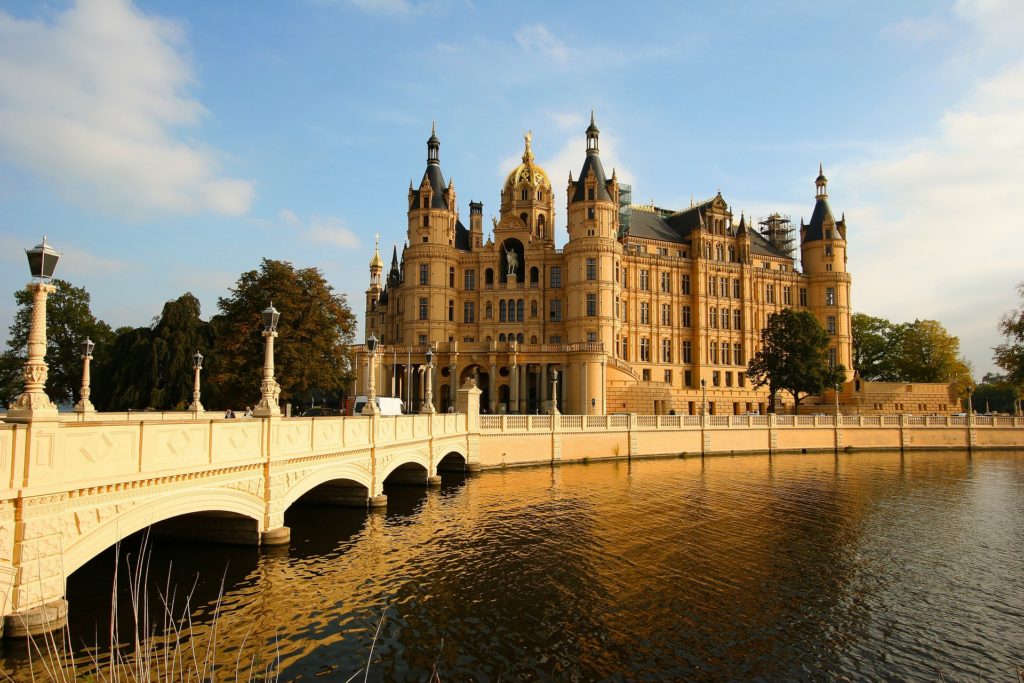
Schwerin is a city well worth a visit. Being the capital of Meck-Pom, it attracts many visitors who come to gaze in wonder at its beautiful old churches and cathedral, its narrow cobbled streets and most importantly the ‘Neuschwanstein of the North’.
The ‘Neuschwanstein of the North’ is the parliament building which is located in an idyllic castle, enveloped by a large lake in the heart of the city. This Schloss (castle), is often compared with Schloss Neuschwanstein in Bavaria, which many may recognise from the film Chitty Chitty Bang Bang and is seen as the inspiration for the Disney castle. Whilst the Schwerin castle may not have Neuschwanstein’s mountainous backdrop, it still has turrets a plenty, beautiful gardens and stunning lake views. It is free to visit the grounds, but it’ll set you back 8 € to venture inside.
Rostock – Meck-Pom’s second city
Rostock is, in many respects, Meck-Pom’s second city. With a population of over 200,000 people and lying directly on the Baltic coast, it is one of the region’s most historically fascinating cities.
The summer months unsurprisingly see Rostock welcoming tourists from all over Germany and also those by ferry from Scandinavia.
Its mixture of colourful Germanic buildings alongside its stark reminders of its communist past, create a distinctive feel. Free access to a former Stasi interrogation unit in the heart of the city alongside speedy connections to the nearest beach, mean that the city offers each visitor a unique experience and can cater for all types of holiday.
Moreover, the Rostock Christmas Market, has been voted as the best market in Northern Germany, and is perfect for a cheeky mulled wine!
Visit Wismar
Wismar, a world heritage site city located west of Rostock is not only another lovely location to visit, but also the region’s second most important port city. Once under Swedish rule, the city has a very Scandinavian feel to it with its many fisheries, colourful harbour buildings and Swedish restaurants.
Like Rostock, it also offers a mixture of GDR history with old abandoned factories alongside beautifully painted narrow streets which follow small rivers towards the Baltic Sea. Walking around the city for several hours and stopping to eat a Fischbrötchen (Fish sandwich), is the perfect way to spend an afternoon in Wismar.
Meck-Pom as the perfect beach holiday
Despite Meck-Pom being home to the stunning above mentioned cities, its best attribute is perhaps its landscape.
When you think about going on holiday to the seaside, your first thought might be sunny southern Spain or perhaps even a Greek island… however, in my opinion, you need look no further than the Baltic coast.
With long golden beaches and beautiful seaside towns such as Warnemünde, Rerik and Kühlungsborn, it is unsurprising that so many Germans decide to head to this part of the world for their beach holiday every year.
The piers, clear blue sea and not forgetting the surprisingly warm temperature in the summer time (30 degrees Celsius), mean that it’s not only in southern Europe where you can enjoy warm weather. The beaches are also accompanied by beautiful white cliffs on the island of Rügen, which is located off the coast of Meck-Pom to the North East. Its white cliffs and gorgeous natural parks offer tourists the opportunity to experience beautiful landscapes.
Meck-Pom as a gateway to the rest of Europe
Its geographical location means that Meck-Pom is also the gateway to other European cities and countries. For example, you can buy a return ferry ticket to Copenhagen from Rostock with a sightseeing trip included for about 40€.
If you were looking to head east to Poland, it only costs 23€ to travel to Stettin, (the closest Polish border city), and is well worth the trip. Moreover, with direct and cheap train and bus travel to Hamburg and Berlin, Meck-Pom is ideal.
So plan a visit to Meck-Pom!
Mecklenburg-West Pomerania is fast becoming my favourite region of Germany. There is something very unique to this region, which you will not encounter elsewhere.
It may not have the chocolate box charm of Bavaria or the international standing of Frankfurt, but the imprints communism has left on the region’s architecture and the allure of the Baltic coast make the region especially unique.
If you want to experience a holiday where you can combine history, nature and beautiful harbour cities, then Meck-Pom is the place for you.
by Hannah Collerson
Dublin, Ireland is one of the most beautiful and mystic cities in the world. Known as the “Emerald Isle”, Ireland is a country full of culture and history. Whether it’s your first visit or you have visited before, there is always something new to see.
Get yourself on one of Dublin’s tours
Scheduling tours are a great idea when visiting Dublin because it will give you a great opportunity to not only see everything but also learn from those who live the culture on an everyday basis.
The Guinness Storehouse – for those who like a drink
The Irish are stereotypically known for enjoying a drink or two, and if you’re fan of beer, Dublin has just the tour for you. The Guinness Storehouse, which is actually shaped like a Pint of Beer, is one of the most popular tourist attractions in Dublin. Guests have the opportunity to see how a pint of the traditional Guinness Beer is created and of course, sample a glass.
Delicious Dublin Tours – get the taste of Dublin
The Delicious Dublin Tours run every Saturday and really offer visitors the chance to experience even more Irish culture. The tours run every Saturday and while traveling through the city, visitors will try traditional Irish cuisine and beverages while touring some of the best restaurants in Dublin.
Dalkey Castle – explore Dublin’s history
To learn more about the deep routed history of Dublin, the Dalkey Castle and Heritage Centre is a must-see. The Dalkey Castle, which was a former port, presents tours that are led by a professional guide that will share tales of what life was like as far back as Medieval Times.
The Writers’ Gallery at the Castle gives visitors the chance to learn more about the history of Irish writers and some of the greatest works that have even been written. Another fascinating part of the Castle’s property is St. Begnet’s Church which is believed to have been a part of the culture since the 10th century.
Family days out
If you are traveling with family or even young children, there are a few places that are definitely worth checking out. The Dublin Zoo is a great place to visit, as one of the oldest Zoos in the entire world, millions of tourists have visited the Dublin Zoo for a one of a kind day of exploring hundreds of animals from around the world.
The AquaZone at the National Aquatic Centre is an indoor aquatic park that will bring visitors of all ages a day of fun. For those who are just looking to take a swim, there is a traditional swimming pool that is great for taking laps if that’s the goal. But, for visitors who want to accelerate their level of fun, there is a water roller coaster, a wave pool, a pool for wave surfing, water slides, a lazy river and much more.
The Imaginosity, Dublin Children’s Museum is definitely a top spot for kids while traveling through the city. The younger members of the family can use their imagination and pretend to take different career paths through various exhibits in the museum. There is also an outdoor section of the Children’s Museum that teaches about gardening and environmentally friendly ways of living.
Dublin’s pubs and cafes
Dublin is known for their pubs and cafes and there are a few that must be on the checklist when in town.
A couple of notable cafes
Butler’s Chocolates has been a staple in Ireland since the 1930’s with their delectable homemade chocolates. The Krust Bakery is a great spot to get a Cronut or other pastry and perhaps a cup of coffee while touring the city.
All over the world, there’s a lot of hype about traditional Irish pubs, and of course you’ll find quite a few in Ireland’s capital.
Traditional Irish Pubs
The Jennings Pub is a place where you can grab a pint and listen to live music too. Besides the Guinness Brewery, Brogan’s Bar gives patrons another opportunity to have a pint of Guinness in a pub fully decorated in Guinness memorabilia.
If you’re a fan of literature, you’ve probably heard of James Joyce. But what you might not have heard of is Joyce’s favourite drinking spot, and Dublin’s oldest pub, The Brazen Head. Joyce even mentioned it in his book Ulysses. The Brazen Head is definitely a spot worth visiting, even if you have no idea who James Joyce is. It’s small but very sweet. It’s full of character, history, and is usually bustling with a load of great people.
As you might expect, Dublin has way too many great pubs for me list them all in this article, but head to Temple Bar and you’ll find most of Ireland’s classic pubs. Temple Bar, believe it or not, isn’t just one bar, but an area, where you’ll find a whole load of places to drink the night away.

Dublin as an artistic experience
For visitors that are looking for to learn more about the arts in Dublin then the museums and galleries should definitely be on the list of stops while visiting.
The National Gallery of Ireland contains thousands of pieces of artwork which include work from Van Gogh and Picasso.
There’s also the Irish Museum of Modern Art which has mostly modern and contemporary styles. There are even studios located on the property.
The National Museum of Ireland-Archaeology is for visitors who appreciate the Viking Era of Dublin and will get to see Celtic pieces in the museum as well.
Farmleigh house and garden attractions
A great place to spend a relaxing afternoon would definitely be on the grounds of the Farmleigh House. Originally built in the 1700s, the Farmleigh House property has a beautiful Clock Tower and Fountain Lawn that are just picturesque. The Benjamin Iveagh Library features a lot of unique and one of a kind Irish literature and newspapers that visitors will find fascinating. There are also various traveling exhibits and Garden Shows that make their way through the Farmleigh House as well, so there is always something to see. Visitors can pick up a delicious coffee and pastry at the Boathouse Café while overlooking some of the best views in the city.
 For visitors who wish to see even more garden properties, the National Botanic Gardens in County Dublin is one of the most popular in all of Europe. The Gardens are a free attraction and visitors can stroll around and see thousands of beautiful rose gardens, ponds, rock gardens and plants that are known solely in Ireland while learning a lot along the way.
St. Patrick’s Cathedral – some history
You’ve heard of St. Patrick’s Day, I’m sure, but a trip to Dublin wouldn’t be complete without visiting St. Patrick’s Cathedral, a part of the country’s history and tradition dating back to the 1200’s. There is an exhibit at St. Patrick’s Cathedral entitled “Lives Remembered” which pays tribute to those lost during World War I. Visitors can take a tour with a guide or take a tour on their own with the use of a designated app that can be downloaded.
No matter what season or who you are there is never a bad time to visit the gorgeous, historical city of Dublin. There is always so much to see and visit that there will never be a dull moment and additional trips, or maybe even trips, might be necessary!
by Hannah Collerson
Gone are the days when acting dumb was cool. Smart really is the new sexy. Intelligence is one of the most highly valued and sought after qualities anyone can have. From having a clearer understanding of the world, to acing pub quizzes, there are so many advantages to being intelligent.
We’re all encouraged to pursue intelligence, and be the best we can be. There’s never any question that knowledge is anything other than good. There’s no list of consequences handed over with your A* grades in high school.
But then, thinking about the old saying, ‘every rose has its thorns’, there must surely be some downsides to having a high IQ. So here are 8 disadvantages you might be familiar with if your IQ is way above average.
1. Your level of patience probably isn’t as high as your IQ
Think about those times when you’re trying to tell someone something, but they don’t hear you. They don’t hear the first time, or the second time, and after the third time you throw your hands up in despair and give up. It’s exactly that kind of frustration that those of higher intelligence experience when people just don’t understand.
We all get frustrated every now and then, but when you’ve got a valid and interesting line of conversation, and people just don’t get it, it drives you insane, right?
Having a high IQ means that every now and then, you’ll find yourself in conversation with others who perhaps aren’t as gifted in the intelligence department. You might be desperate to offload your thoughts about some new philosophical question that’s arisen, or give your opinion on the latest state of political affairs, but everyone you try and talk to just doesn’t have a clue what you’re talking about.
The chances are that whilst your IQ is sky high, your level of patience probably isn’t quite as impressive. Explaining concepts and issues in layman’s terms, when you have a deeper understanding, is a good skill to have, but when it’s a constant requirement of every conversation, it can be infuriating.

2. Little achievements go unnoticed
Think back to when you went to school, were your classes split into higher and lower sets? If they were, and if you ever found yourself in the higher set, you might have noticed those in lower sets were rewarded for things that were just expected of you.
Maybe someone got an award in assembly for finally memorising their times tables, something you did months, maybe years, before. It can feel pretty unfair, and it’s not something that necessarily stops when you leave education either.
If you’ve grown up with more being expected of you than most, because you have the ability to excel more than most then the chances are that throughout your life, it won’t just be others expecting more from you, but rather you expecting more of yourself.
You’ll push yourself, and sure, at times that will be a good thing, the more you push yourself the further you’ll go. But if you don’t reach your goals, and you don’t get to wherever it was that you thought you were going, you might feel like you’ve let yourself down more than anyone else. And despite however many achievements you may have made along the way, you might not even recognise them as notable.
3. Complacency – the intellect’s downfall
On the other hand, rather than pushing yourself too hard, you might find yourself not putting any effort in at all, because you might not need to!
Things that others need to work hard for, and put time and effort into, you might be able to do without a moment of preparation. Think again of your school days, and how there’s always some who can put in minimal effort, perhaps only revising a few hours before an exam, and do better than those that had been revising for months.
It’s great to be able to breeze through life without much work, worry or stress, but that’s when you become complacent. You’ll be pleased with your achievements, and probably quite smug. Obviously there’s no real harm in that, but the likelihood is that everything you attempt, you’ll approach with the same lack of effort that got you the results of your previous achievements.
Eventually though, you might come across something that’s not as easy to breeze. And if you’ve already got into the habit of not needing to do much work, you might struggle more than those that are used to challenges.
4. Ignorance is bliss
Most of us, if not all, can probably think of a time when we became aware of something that it would’ve been easier to remain unaware of. Whether it was something that hurt to find out, or just some grim detail about your mate’s personal life that wish you’d never heard. Sometimes the truth can be hard to swallow, and we long for ignorance. As the saying goes, ignorance is bliss.
But when you’re gifted with a higher than average intelligence, ignorance can be hard to come by. Others might be fooled by the well worded speeches and false promises of politicians, whilst you instead let the economy talk for itself. Sure, it would be nice to believe that things will change for the better, taxes might go down, and standard of living might go up, but generally, the more intelligent of us are also realists.
When you know more than most, there’s not really any way you can blindly believe promises of change and improvement without first turning to the facts of history, and the stats of today.
5. The more you know, the more you realise you don’t know
With everything you learn, you’ll be constantly realising how much more there is to learn that you haven’t even looked at yet. No one person will ever have complete understanding of anything, and as soon as you realise that, the pursuit of knowledge begins.
You’ll pursue as much knowledge as you can, but ultimately there’ll always be an underlying frustration at the fact that there’s just not enough time in the world for you to grasp everything.
Despite your relatively high intelligence, you might feel overwhelmed by the amount you don’t know, and disheartened by how little you know in comparison. To be humble isn’t a bad trait, but you have a right to feel proud of your level of intellect.
6. Being smart can actually lead to sleepless nights
We’ve all had nights were we’ve sat awake till the early hours, going over and over something that’s already happened, or dwelling on something that might never happen.
But if you’ve got a higher IQ, you probably overthink things more than those without your level of intelligence. From analysing each word of a past conversation, to assessing the possible outcomes of future situations, to panicking about politics, your overly active mind can actually stop you from getting a good nights sleep.
The trouble with a great mind, is that it’s pretty hard to stop it whirring thoughts round and round, all hours of the day.

7. You tend to ignore your heart, and follow your head
We all know someone who’s taken huge risks, ignoring their head and following their heart, even if it leads them into trouble. Those of extreme intelligence though are more likely to do the opposite – ignore their heart.
You can’t really go wrong with allowing logic to dictate your choices ,but when it means your heart goes ignored, at point do you allow yourself to feel?
Feeling and loving is what makes us human. There are obvious, well reasoned and clever choices, and then there are impulsive decisions that ignore what we should do, and take advantage of what we can do. Letting yourself be vulnerable is sometimes just as important as protecting yourself. That’s what living is.
8. You might become what they call a ‘Grammar Nazi’
Think about times you’ve heard people talking about something you’re particularly clued up on, and they’ve got the facts wrong, you were probably dying to correct them. It’s natural.
With social media on the rise, this is particularly relevant in grammar. Every day you see misspelt statuses and comments full of grammar mistakes. And then you see other comments, by the perhaps more intelligent, correcting the mistakes.
You might have heard the term ‘grammar nazi’ thrown around at those who are sticklers for perfect spelling and sentence constructions. And its exactly those that find themselves subject to the phrase ‘grammar Nazi’. The more you understand the rules of grammar, the closer you get to becoming the living and walking demonstration of the term.
by Hannah Collerson
British Columbia, Canada’s western-most province, stretches from the coast of the Pacific Ocean east to the Rocky Mountains, from Vancouver Island’s southern tip, to the prairies of the north-eastern Peace River country. Settled amongst the breathtaking natural vistas, in the mountain valleys, and along the rugged coast, you will find a land ripe for exploration and teeming with culture.
With so much ground to cover, here’s a quick guide to making the most of British Columbia.
Adventure in British Columbia
If you’re looking for adventure, then British Columbia is the place for you.
Adventure in Winter
If you visit in the winter months, bring your snowshoes, skis, snowboard and, of course, a toque. The world-renowned Whistler-Blackcomb resort, home of the 2010 Winter Olympics, boasts an incredible array of winter activities. The Whistler-Blackcomb Ski Resort has weeks worth of terrain for skiers and snowboarders of all skill levels to enjoy. You can also find snowmobiling, snowshoeing, and dogsled tours through the breathtaking pristine mountain landscapes.
If you want to break your own trail, British Columbia is also home to one of the world’s largest heli-sking industries. Ride the fluffiest, deepest powder imaginable in various locations across the province, from the Mike Wiegele Helicopter Skiing’s Lodge in the Rocky Mountains, to Nelson’s Baldface Lodge in the heart of the Selkirk Mountains.

Adventure in Summer
If you visit during the warmer months, British Colombia still has plenty to offer.
How about some of the best angling in the world? Senora Island Resort, the Long Beach Lodge, and the Fraser River Fishing Lodge are just a few of the world-class destinations for both unbelievable salt and fresh water fishing.
Go kayaking with the whales in Blackfish Sound, amazing multi-day camping and kayaking tours make for an unforgettable experience. Want to go a little deeper? Book some world class scuba diving and snorkeling trips with Sea Dragon Charters in Vancouver, or Sundown Diving in Nanaimo on Vancouver Island.

British Columbia is also home to an extensive and intricate network of hiking trails and camping locations. With over 800 maintained trails and parks throughout the province, including the world-renowned West Coast Trail, a getaway to the great outdoors is never far away. From full-service RV campgrounds, to hike-in backcountry lodges, everyone and anyone can explore the natural beauty of British Columbia.
History & Culture
If kayaking and skiing all sounds like a bit much for you, British Columbia has plenty to offer in terms of history and culture. The Coast Mountain Range isn’t just breathtaking landscapes, it’s been home to unique and iconic cultures for thousands of years.
The City of Vancouver hosts a robust collection of indigenous cultural showcases, from Stanley Park’s totem pole display at picturesque Brockton Point, to the Bill Reid Gallery of Northwest Coast Art.
Vancouver Island’s Ahtsik Native Art Gallery houses the art and history of the islands unique First Nations communities, and entering the traditionally carved and constructed longhouse that is the Eagle Aerie Gallery in Tofino transports visitors back to a time long before European arrival.
Venturing into the province’s interior you can find the unique Nk’Mip (in-ka-meep) Desert Cultural Centre in Osoyoos, home to Canada’s only desert and the unique art and culture of its indigenous people. Further north, in a drastically different landscape and climate, the Museum of Northern British Columbia in Prince Rupert hosts unique indigenous glass artwork, carvings, and cultural artifacts.
Vancouver’s historic Gastown district is one of the oldest and most functional historical neighborhoods in the province, with buildings, streets and even a steam-clock preserved in their late 19th-century glory.
Victoria boasts the spectacular Parliament Buildings and historic harbour, featuring the splendour of the Parliament’s Romanesque/Baroque style and the Royal BC Museum is a stone’s throw away with its expansive galleries on natural history, indigenous culture, and modern history.
British Columbia was home to many boom-to-bust mining towns and mini-gold rushes, their legacies can be found in eerily vibrant ghost towns. Barkerville, in the central interior of the province, is the liveliest example, with historical re-enactments that will let you experience first-hand the life of a gold prospector in the 1860’s frontier.
Food & Drink
All this natural splendor and adventuring can work up quite an appetite, and you won’t be wanting for good eats in BC. Vancouver and Victoria are both culturally diverse metropolitan cities, bringing a world of culinary experiences right to your plate.
Oriental
Some of the freshest, finely crafted sushi in the world can be found here. While high profile restaurants like Vancouver’s Sushi Itoga, or Victoria’s Osaka Sushi provide a high-faluten atmosphere, don’t look past the mom-and-pop sushi bars that modestly boast some of the most delicious sashimi and innovative sushi rolls money can buy.
Vancouver has a huge array of culinary options, reflecting the diversity of the city’s population. Some of the best authentic Chinese dishes can be found at places like Peaceful Restaurant in Vancouver, or across the Fraser River at Shanghai Morning Restaurant in Richmond. Sula Indian Restaurant provides some of the best East Indian dishes in town, while the Banana Leaf serves up unique Malaysian masterpieces.
Local
But if you want a truly local taste, take a stroll down Vancouver’s historic Commercial Drive and south Main Street, where you will find a cacophony of restaurants, cafes, and tapas bars. Vegetarian comfort food, sushi burritos, gluten-free bakeries, micro-brewed craft beers, local wines, and much more can all be found just by taking a stroll down the streets of these culinary hubs.
In the Okanogan Valley, you can find the heart of BC’s booming wine industry. With almost 350 licensed wineries, you can find something for even the pickiest Oenophile. Beautiful vistas will accentuate a wine tasting and touring experience like no other.
If you find yourself in Victoria, head to the Fairmont Empress. The Empress is famous for its traditional afternoon tea, and is great for a lazy afternoon, drinking tea beside the harbour. It might be a welcomed chance to relax after all the sightseeing and adventuring!

Shopping in British Columbia
Vancouver is probably the one-stop-shop destination of British Columbia. It boasts major retailers, such as Holt-Renfrew and the newly opened Nordstroms, in the city’s downtown core on the entertainment and shopping thoroughfare Granville Street. Historic Gastown and Granville Island boast high-end fashion, local and international art, and unique boutiques for the savvy shopper.

Victoria has a humbler shopping experience. Market Square showcases local goods and wares in its open-air plaza, while the Esquimalt Farmers Market provides food, music and local handicrafts unique to Vancouver Island’s culture. Munro’s Books is one of Canada’s finest independent bookstores. Voted the third-best bookstore in the world by National Geographic in 2016! The collection of knowledge, art, and imagination kept in this historic bank-turned-Bibliotheque is absolutely world class.
No matter where you find yourself in the province, unique indigenous art can be found for sale, often directly from the artists. Soapstone and timber carvings, fine glass work, traditional jewelry fashioned with BC Jade, unique artwork and cultural icons are unique souvenirs and a great way to support the local communities and cultures.
British Columbia has all this to offer, and more.